
- Product
AgSAP® - Agricultural Super Absorbent Polymer
Super absorbents that are specifically designed for agriculture and water conservation in soil. The first US Patent for a super absorbent was awarded in 1961 for an agricultural application!
AgSAP® (Agricultural Super Absorbent Polymer), is a Potassium-neutralized acrylic-acrylamide co-polymer that withstands numerous wet/dry cycles. The product releases moisture to plant root hairs and is replenished as a water reservoir whenever the soil receives rain or water irrigation.
Water Conservation Technology for Sustainable Agriculture
AgSAP® (Agricultural Super Absorbent Polymer) represents a significant tool in agricultural water management, delivering advanced soil amendment technology for water conservation and crop productivity. This potassium-neutralized acrylic-acrylamide co-polymer transforms how plants access water, creating a sustainable reservoir system that can reduce irrigation needs by up to 50% while improving crop yields and soil health.
Proven Science, Exceptional Results
Building on over 60 years of superabsorbent innovation—the first US patent for agricultural superabsorbents was awarded in 1961—AgSAP® delivers unmatched performance through its unique wet/dry cycle durability. Unlike conventional water retention products that degrade quickly, AgSAP® maintains its water-holding capacity through numerous irrigation and weather cycles, providing years of consistent performance in soil.
Advanced Product Engineering
Potassium-Neutralized Superabsorbent: Provides steady water availability to the plant root hairs. Wet/Dry Cycle Durability: Maintains performance through numerous irrigation cycles Multi-Size Options: Three particle sizes for optimized application methods Root-Zone Activation: Releases moisture directly to plant root hairs on demand Long-Term Performance: Remains active in soil for multiple growing seasons 50% Water Reduction: Proven capability to reduce irrigation frequency and volume by half
Particle Size Options for Every Application
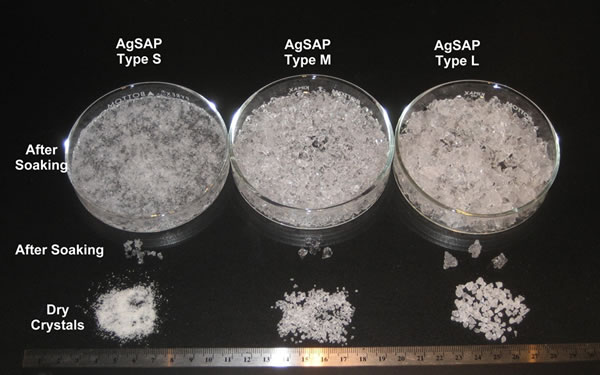
Small Granulation (Type S): 200-800 µm - For seed coating, transplant applications, and fine mixing Medium Granulation (Type M): 1-2 mm - For broadcast application and soil incorporation
Large Granulation (Type L): 2-4 mm - For tree planting, landscape installation, and specialized applications
Comprehensive Agricultural Applications
Field Crop Production
- Corn and soybean farming for drought stress reduction and yield optimization
- Wheat and grain production in water-limited growing regions
- Cotton cultivation for improved fiber quality and reduced irrigation
- Rice agriculture for water-efficient paddy management systems
- Potato and root crop farming for consistent moisture and improved storage quality
- Sugarcane production for enhanced water use efficiency in tropical regions
Fruit and Tree Crop Applications
- Orchard establishment for young tree survival and rapid establishment
- Citrus grove management for consistent fruit quality and reduced water stress
- Apple and stone fruit production for improved fruit size and quality
- Nut tree cultivation including almonds, walnuts, and pecans
- Avocado farming for water-efficient production in arid regions
- Vineyard management for enhanced grape quality and drought tolerance
Vegetable and Specialty Crop Growing
- Tomato and pepper production for consistent yields and quality
- Leafy green cultivation for extended harvest periods
- Root vegetable farming including carrots, beets, and radishes
- Cucumber and squash production for improved fruit development
- Herb and spice cultivation for enhanced oil production and flavor
- Specialty crop farming for high-value niche markets
Greenhouse and Controlled Environment Agriculture
- Hydroponic system enhancement for nutrient solution management
- Potting mix formulation for container growing operations
- Seedling production for improved germination and early growth
- Cutting propagation for enhanced rooting success rates
- Growing media amendment for soilless production systems
- Nursery stock production for consistent plant quality
Landscaping and Turf Management
- Golf course maintenance for consistent playing conditions with reduced irrigation
- Sports field management for durable turf under heavy use
- Residential lawn care for homeowner water conservation
- Commercial landscape installation for drought-tolerant designs
- Highway and roadside vegetation for low-maintenance establishment
- Municipal landscaping for sustainable urban green spaces
Forestry and Reforestation Projects
- Tree planting programs for improved seedling survival rates
- Forest restoration in degraded or fire-damaged areas
- Urban forestry for street tree establishment and maintenance
- Watershed restoration for erosion control and habitat improvement
- Christmas tree farming for consistent growth and needle retention
- Timber plantation establishment for commercial forest operations
Soil Remediation and Restoration
- Erosion control projects for slope stabilization and revegetation
- Mine site rehabilitation for vegetation establishment on disturbed soils
- Contaminated soil treatment to support phytoremediation efforts
- Desert reclamation for vegetation establishment in arid environments
- Construction site revegetation for post-project restoration
Organic and Sustainable Agriculture
- Organic certification compatible for environmentally conscious farming
- Permaculture design for water-efficient food forest systems
- Regenerative agriculture for soil health improvement and carbon sequestration
- Biodynamic farming for enhanced soil vitality and water retention
- Cover crop establishment for soil improvement and moisture conservation
- Companion planting systems for optimized water and nutrient sharing
International Development and Aid
- Subsistence farming in water-scarce developing regions
- Food security projects for improved crop reliability
- Agricultural extension programs for farmer education and adoption
- Refugee agriculture for sustainable food production in camps
- Disaster recovery farming for rapid agricultural restoration
- Climate adaptation for farming under changing precipitation patterns
Research and Development Applications
- Agricultural research plots for controlled water stress studies
- Plant breeding programs for drought tolerance evaluation
- University extension demonstrations for farmer education
- Corporate R&D testing for new crop variety development
- Climate change adaptation research for future farming strategies
- Precision agriculture for data-driven water management optimization
Specialized Growing Applications
- Mushroom cultivation for controlled moisture environments
- Microgreen production for consistent growing conditions
- Flower bulb farming for quality flower production
- Seed production for improved germination and viability
- Medicinal plant cultivation for consistent active compound production
- Aquaponics systems for integrated fish and plant production
The AgSAP® Advantage
Immediate Impact: Plants benefit from improved water availability within the first irrigation cycle, with visible improvements in growth and stress tolerance.
Economic Returns: The 50% reduction in irrigation frequency translates directly to lower water costs, reduced labor, and improved crop yields—typically providing ROI within the first growing season.
Environmental Stewardship: By dramatically reducing water usage and preventing nutrient leaching, AgSAP® supports sustainable agriculture practices and environmental conservation goals.
Versatile Application: Whether incorporated during planting, applied to existing crops, or mixed into growing media, AgSAP® adapts to virtually any agricultural operation.
Long-Term Value: Unlike annual inputs, AgSAP® continues providing benefits for multiple growing seasons, making it one of the most cost-effective soil amendments available.
Technical Performance Data
Water Retention: Absorbs and holds 300+ times its weight in pure water Particle Sizes: Three options from 200 µm to 4 mm for diverse applications Cycle Durability: Maintains performance through numerous wet/dry cycles Irrigation Reduction: Proven 50% reduction in watering frequency Soil Life: Remains active for multiple growing seasons Nutritional Benefit: Potassium content supports plant health and productivity
Transform Your Agricultural Operation
From small-scale organic farms to large commercial operations, from greenhouse production to field crops, AgSAP® delivers measurable improvements in water efficiency, crop quality, and profitability. Our three particle sizes ensure optimal performance regardless of your application method or crop type.
Ready to revolutionize your water management? Contact M² Polymer Technologies for application guidance, technical specifications, and product samples tailored to your specific agricultural needs.
Agricultural SAP® (AgSAP®) - FAQs
What is AgSAP® and how does it work as a soil amendment?
How much can AgSAP® reduce irrigation requirements?
How long does AgSAP® last in soil?
Is AgSAP® safe for food crops?
What is the recommended application rate for AgSAP®?
What is the history behind agricultural superabsorbent polymers?
Can AgSAP® be mixed with fertilizers?
AgSAP® is compatible with most standard granular and water-soluble fertilizers. Because the polymer retains water in the root zone, it can also help retain water-soluble nutrients near plant roots, potentially reducing fertilizer leaching in sandy and high-drainage soils. However, high salt concentrations from certain fertilizers can reduce SAP absorption capacity, so we recommend testing combined applications before large-scale use. Contact our technical team for specific compatibility guidance.
Partner With M² Polymer
Drive innovation and efficiency with our advanced polymer solutions tailored to your industry needs.
Email Us
Phone Number
Get in Touch
Fill out the form below, and our team will reach out with personalized recommendations and support.